



For more information please visit the website here
Market Trends and MSP Growth
Jones opened the discussion by highlighting the buoyancy of the MSP market, noting that Kaseya experienced 16% organic growth in the past year on revenues of approximately $1.5 billion. He emphasized that 98% of Kaseya’s business comes from MSPs, reinforcing the sector’s strength.
Cooke then provided insights into key industry trends, stating that competition has historically driven MSPs to lower their prices, but this focus may now be shifting towards profitability, growth, and innovation. “We’re seeing that MSPs who embrace automation and innovation are the ones driving the most business success,” he noted.
Challenges and Strategic Shifts for MSPs
One of the major concerns for MSPs has been client acquisition and profitability. Jones pointed out that the number one reason clients leave their MSPs is a lack of necessary services or technology. He advised MSPs to reevaluate their offerings and ensure they align with market demands.
Cooke introduced the concept of MSPs evolving into Business Service Providers (BSPs), a shift that emphasizes deeper client engagement beyond traditional IT services. “MSPs that embed themselves in their clients’ businesses can command significantly higher price points,” he stated, citing examples of MSPs successfully charging £100+ per user in the UK and over $250 per user in the US using this approach.
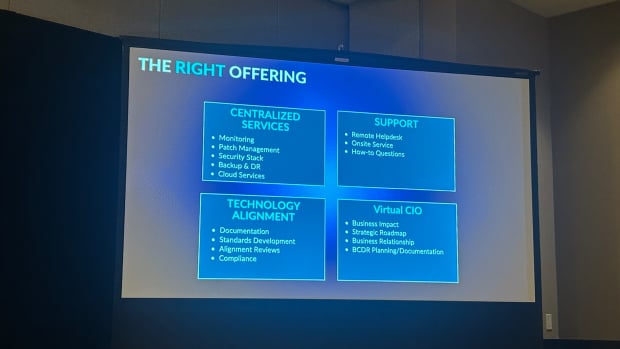
To facilitate this transition, Cooke outlined a structured model where MSPs separate roles into four defined areas:
- Support Services – Handling immediate technical issues.
- Centralized Services – Focused on automation and efficiency.
- Technology Alignment Managers – Working closely with clients to proactively identify business needs.
- vCIO (Virtual Chief Information Officer) – Acting as a strategic advisor to clients.
He compared this to a restaurant model, where defined roles enhance service quality: “You wouldn’t expect one person to greet customers, take orders, cook the food, and mix the drinks. The same principle applies to MSPs.”
The Growing Role of Compliance as a Service
Jones introduced compliance as a key growth opportunity for MSPs, citing data from major industry analysts that predict the compliance market will be worth $75 billion by 2028. He argued that compliance services offer high margins and strong client retention, providing a lucrative area for MSPs to expand.
He outlined six steps for MSPs to capitalize on compliance:
- Assess current capabilities – Determine if internal resources can support compliance services.
- Identify target markets – Look for regulated industries with specific compliance requirements.
- Develop service offerings – Choose whether to build or outsource compliance solutions.
- Implement a strong pricing model – Avoid discounting and focus on profitability.
- Invest in training and certifications – Build expertise to differentiate from competitors.
- Prioritize sales and marketing – Emphasize compliance as a value-add for clients.
Jones reinforced the importance of a strategic sales and marketing approach, stating that the fastest-growing MSPs invest heavily in these areas.
Proven Strategies for MSP Growth
The session concluded with testimonials from MSPs participating in Kaseya’s True Peer program, designed to improve operational efficiency and profitability.
Ian Dunstan from Cobalt, an MSP leader who recently joined the program, shared his experience:
“I had been running an IT business for 25 years, but I realized I wasn’t charging my customers nearly enough. The program helped me redefine my pricing and strategy, leading to a much more scalable and profitable model.”
Another participant, Mathew Elson, Indigo IT, highlighted the operational impact:
“We’ve been in the program for 14 months, and just by implementing structured roles and alignment processes, we’ve transformed our business – and we haven’t even touched the sales strategies yet!”
Simon Gurner of Sunrise Technologies credited the program with doubling his revenue from $1.1 million to $2.3 million in just four years. “It was all about process, structure, and getting the right people in place,” he said.
Jones wrapped up the discussion by encouraging MSPs to rethink their business models, invest in compliance services, and leverage structured growth strategies. “If you want to be among the top 10% of MSPs in profitability, you need to evolve. The market is changing, and those who adapt will thrive.”
Conclusion
The session provided valuable insights into the evolving MSP landscape, emphasizing the need for strategic pricing, role specialization, and expansion into compliance services. Jones and Cooke made it clear that the MSP model is shifting, and those who embrace change will have the best opportunities for growth and success.