


John McAfee, Five Years On

Lover, Adventurer, Poet: John McAfee, 5 Years On
In one of his last interviews before his death, John McAfee joked about his tombstone and aired his disdain for centralised authority and the SEC.
Five years after John McAfee died in a Spanish cell, his place in crypto is still an argument, not a verdict. Prophet of financial freedom, serial coin-promoter, or a fugitive using borderless money to stay ahead of the law? The uncomfortable answer is that the same blockchain made all three true at once.
He died on 23 June 2021, found hanged in a prison near Barcelona hours after Spain’s High Court approved his extradition to the United States. The death was ruled an apparent suicide, a finding his family has always disputed. What he left behind in crypto is not a clean legacy but a Rorschach test: look at the record one way and you see a libertarian visionary; tilt it slightly and you see a grifter; tilt it again and you see a man on the run, monetising his own notoriety from international waters. The reason the picture keeps shifting is the technology itself. Crypto was uniquely suited to McAfee because it could be a sovereignty movement, a promotion machine and an escape route, often in the same breath.
The prophet
To McAfee, decentralisation was not a financial strategy but a creed. He cast cryptocurrency as a weapon against state control, contrasting the friction of the banking system with a single principle: “your wallet is your bank.” He ran for the US presidency twice on an anti-establishment platform, and in 2019 he built the purest expression of his politics in code. McAfeeDEX, launched in beta in early October 2019, was a non-custodial exchange on Ethereum designed to be ungovernable: no identity checks, no listing fees, no central server to seize, deliberately spread across multiple hosts so that, in his framing, it “can’t be shut down.” For the believers, this is the McAfee who matters, the one who tried to hand individuals a financial system no government could reach.
The promoter
The same Twitter feed that preached sovereignty was also, by his own admission, for sale. In March 2018, at the peak of the ICO mania, McAfee’s crypto team publicly advertised a rate of $105,000 per promotional tweet to his roughly 810,000 followers. Regulators later cast that business in a far harsher light. On 5 October 2020 the SEC charged him with fraudulently touting initial coin offerings without disclosing he was paid, alleging he took more than $23 million in digital assets to promote tokens while presenting himself as impartial. The same day, federal prosecutors in Manhattan unsealed a criminal indictment charging McAfee and an associate with fraud and money-laundering conspiracy; together, the US Attorney said, the schemes “raked in more than $13 million from investors they victimised.” None of it was ever tested at trial; McAfee died before he could answer the charges, and the allegations remain exactly that. But the paper trail is real, and to his critics it is the truer portrait: not a prophet, but a salesman who had found the perfect product. The token he is most remembered for, $WHACKD, still trades today.
The fugitive
The third McAfee was simply running. In January 2019 he announced he was living “in exile” on a boat in international waters, saying he had been indicted on tax-related felonies, and he never again set foot in the United States as a free man. A grand jury in the Western District of Tennessee charged him in June 2020 with tax evasion and failing to file any return from 2014 through 2018, years in which, prosecutors alleged, he earned millions from crypto promotion, speaking, consulting and the sale of his life story. For a man in that position, crypto was less an ideology than infrastructure: it moved value across borders without a bank, and McAfeeDEX, built while he was already a fugitive, asked for no identity that could betray his own. He was arrested at Barcelona’s international airport in early October 2020 on the US extradition request, and held in Spain until the morning he died. The contract he named “Epstein”, the death itself, and the market that moved around it are each their own thread.
The unresolved verdict
The temptation is to pick one of these men and call him the real one. The record resists it. The prophet, the promoter and the fugitive are not three theories competing to be true; they are three things that were true together, held in place by a technology flexible enough to serve all of them. That is the uncomfortable shape of McAfee’s crypto legacy, and five years after his death it has not resolved, because nothing about the man ever did.
The Series — Seven Articles
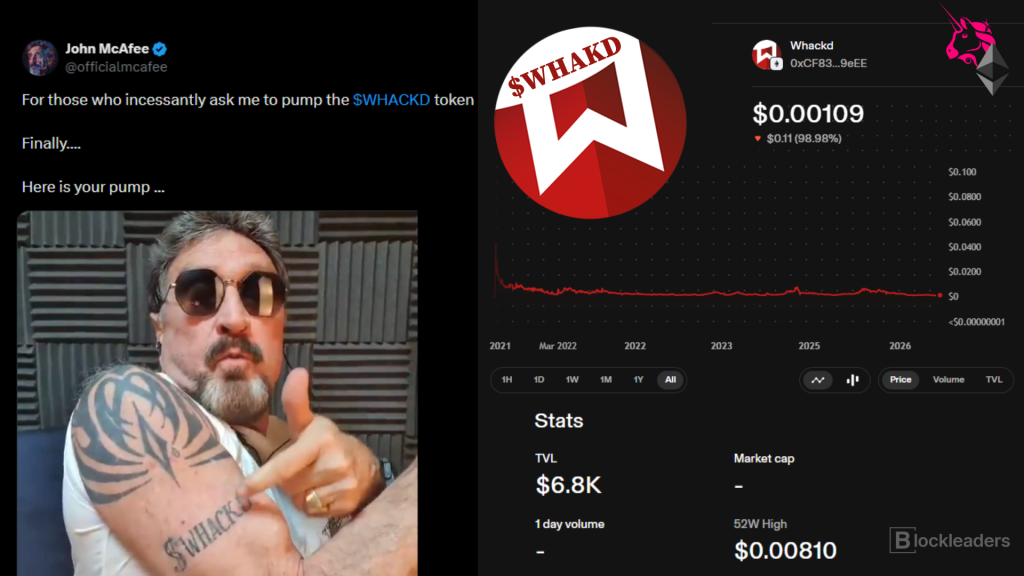
$WHACKD Explained: McAfee’s ‘Dead Man’s Switch’ Coin, Five Years Later
$WHACKD is John McAfee's deflationary 'dead man's switch' token, its contract named 'Epstein'. What it is, what became of it, and the truth five…

Suicide or ‘Whackd’? An Objective Look at the McAfee Death Controversy
Spain ruled John McAfee's 2021 prison death a suicide. His widow disputes it, and he warned he'd be 'whackd'. An evidence-led look at both…

McAfeeDEX and the Unfinished War on KYC
Before DeFi went mainstream, John McAfee launched a no-KYC DEX and dared regulators to stop him. McAfeeDEX, and the unfinished war on KYC.
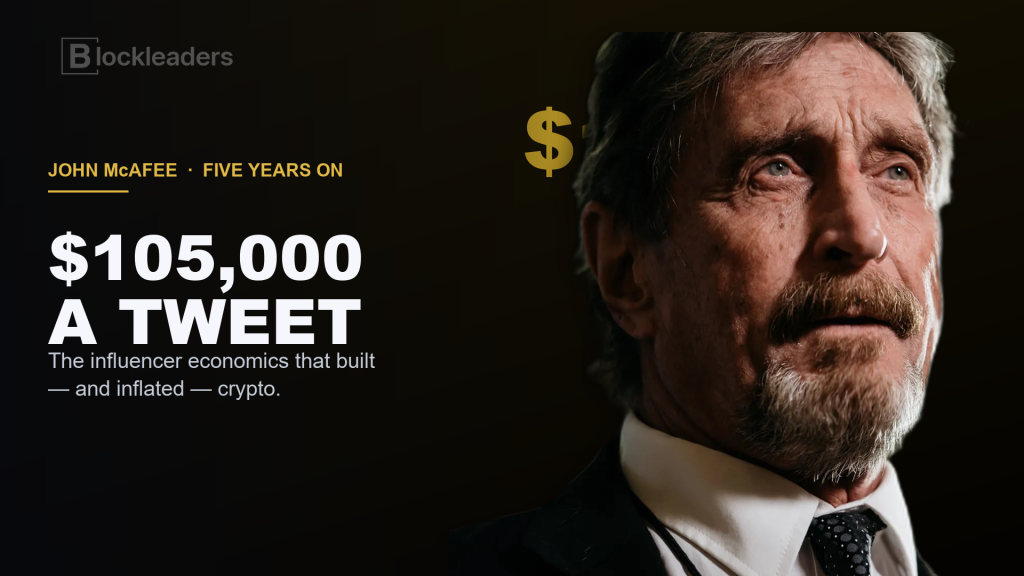
$105,000 a Tweet: The Influencer Economics That Built and Indicted McAfee
$105,000 a tweet: the influencer economics that built John McAfee's crypto megaphone, and helped indict him.

The Epstein Contract: How McAfee Engineered Conspiracy Into Code
John McAfee named his token's smart contract 'Epstein', on purpose, in code that cannot be edited. The on-chain story of a conspiracy written into…

Bull to Bear: The Crypto Market When McAfee Spoke, When He Died, and Now
The crypto market when McAfee spoke, when he died, and now: five years of cycles mapped, in one of the roughest stretches since.
Catch-up on Crypto in 5 minutes.
We publish the headlines about the headlines, covering the blockchain action that matters, plus a featured weekly crypto leadership profile.