


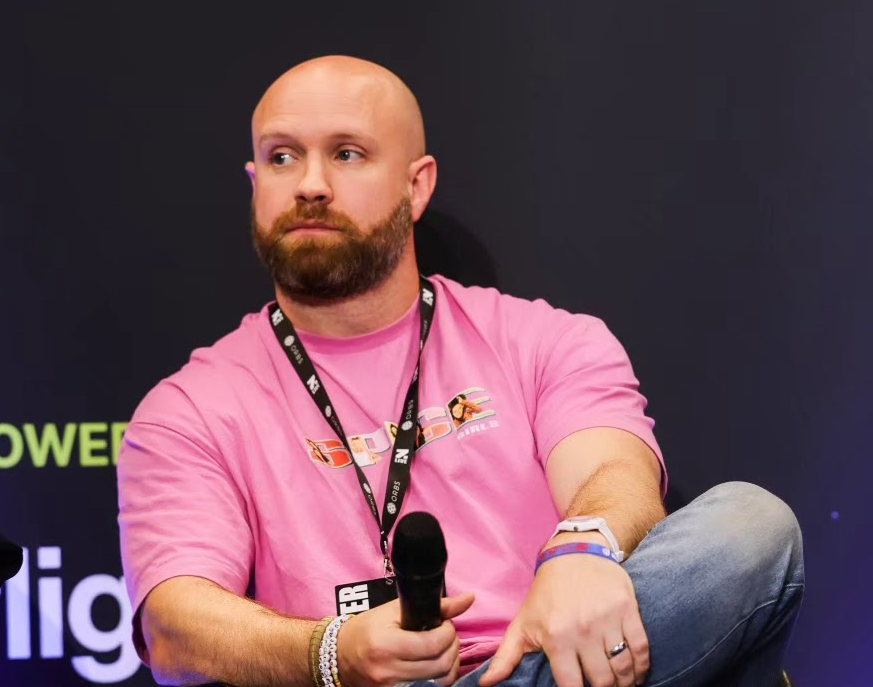

When Ben Lee walks into a room, you don’t immediately think “tax partner.” He’s more likely to be wearing flip-flops or rainbow Crocs than a pair of brogues. It’s a look that says he’s comfortable being himself, even in a world known for its grey suits and cautious phrasing.
Lee is a partner at Andersen, one of the UK’s most active firms in digital asset taxation. Before that, he played rugby, studied chemistry, and learned to code. It’s an unusual combination, but one that makes sense once you meet him.
“I’ve always liked taking things apart to see how they work,” he says. “Whether that’s a molecule, a scrum, or a tax code.”
He grew up around computers. “My dad used to work for ICL before Fujitsu bought them,” he recalls. “He’d bring computers home, and I’d spend hours programming in BASIC. The idea that I could write something and have it come out of a printer completely fascinated me.”
At school, he split his time between the computer room and the rugby pitch, until he had to choose. “You couldn’t do both,” he laughs. “You were either in the geek camp or the jock camp. I tried to straddle both, but the rugby coach won.”
He studied chemistry at university but admits he’s long since forgotten the details. “I read my dissertation the other day and didn’t understand a word. It’s so niche it might as well have been written in another language.”
After graduation, Lee did what he describes as the logical next step for someone good at exams, he became an accountant. “Accountancy is safe,” he says. “Structured, controlled, defined. For some people, that predictability is comforting.”
Then crypto came along and changed everything. “It blew the doors off,” Lee says. “Crypto raised questions traditional accounting wasn’t ready for. It appealed to my problem-solving brain. It also stood for something – transparency, equality, access.”
He was already comfortable in the world of data. “Even before crypto, I got frustrated with accounting software,” he says. “It wouldn’t do what I wanted. So I learned SQL, wrote my own queries, and automated things that used to take hours. I remember cutting a six-hour reporting process down to three seconds.”
That same mindset carried into his crypto work. “One client had more than three million transactions,” he recalls. “There isn’t a commercial package on the market that can handle that volume. So we built our own Python solution using the Solana API.”
He calls it “the nerdy stuff,” but it’s the kind of innovation that has made Andersen’s crypto practice one of the most respected in the UK.
“We’re not just applying old frameworks to new assets,” Lee says. “We’re rethinking what good accounting looks like in a tokenised world.”
Still, he’s quick to point out that most accountants haven’t caught up.
“We still hear people saying there’s no tax until you convert to fiat,” he says. “That’s wrong. And when a client hears it from another accountant, they believe it. It’s frustrating because it shows how little the profession has adapted.”
His tone is more exasperated than critical. “In the UK, people think tax is optional,” he says. “It’s not. It’s a subscription model for living in a country. You don’t get to opt out.”
Lee’s curiosity extends into technology’s next wave – AI. He sees both promise and pitfalls. “I like large language models,” he says. “They can pass tax exams now, but they still get basic things wrong. They’re designed to agree with you, not challenge you. We’ve even had clients quote ChatGPT to dispute our advice.”
It’s part of what he calls “the Google generation of advice,” where people treat search results as expertise. “The risk is that people stop seeking proper advice altogether,” he says. “That’s going to cause more problems down the line.”
When asked what drew him to Andersen, he mentions both timing and trust. “When I first proposed doing crypto tax work at my previous firm, it was rejected. It was a partnership of roughly 53 men, and 3 women. A year or so later they hired a new marketing director, and I’ll never forget the day she said to me ‘Just run with it.’ So I did.”
That decision changed the trajectory of his career. After leaving his previous firm and joining Andersen, their crypto tax team is one of the most recognised in the UK, shortlisted twice for the Tolley’s Tax Awards. “We’ve never won,” he says. “My cynical view is the judges don’t understand crypto, which probably proves how specialist it is.”
Lee recently co-authored Crypto Asset Taxation, published by Bloomsbury Professional, Zoe Wyatt and Dion Seymour. “Zoe’s internationally focused, Dion’s ex-HMRC, and I bring the domestic practitioner’s view,” he says. “We wanted to write something accessible, not just for other advisors, but for business owners and anyone trying to make sense of crypto.”
The book took nearly a year to complete and had to be rewritten several times as regulations evolved. “It’s like trying to paint a moving train,” he says. “The rules keep shifting.”
He’s modest about recognition but proud of the clarity the book brings. “Everyone thinks crypto’s new, it isn’t. Everyone thinks it’s untaxable, it is. We just wanted to give people something clear, practical, and real.”
For all his achievements, Lee still carries the same energy that took him from rugby pitches to data queries. “I like the nerdy stuff,” he admits with a grin. “I like making things work.”
And yes, he still turns up in rainbow Crocs. “You have to be comfortable in your own skin,” he says. “That’s probably the most important thing, in tax or in life.”
In conversation at ZebuLive 2025


