


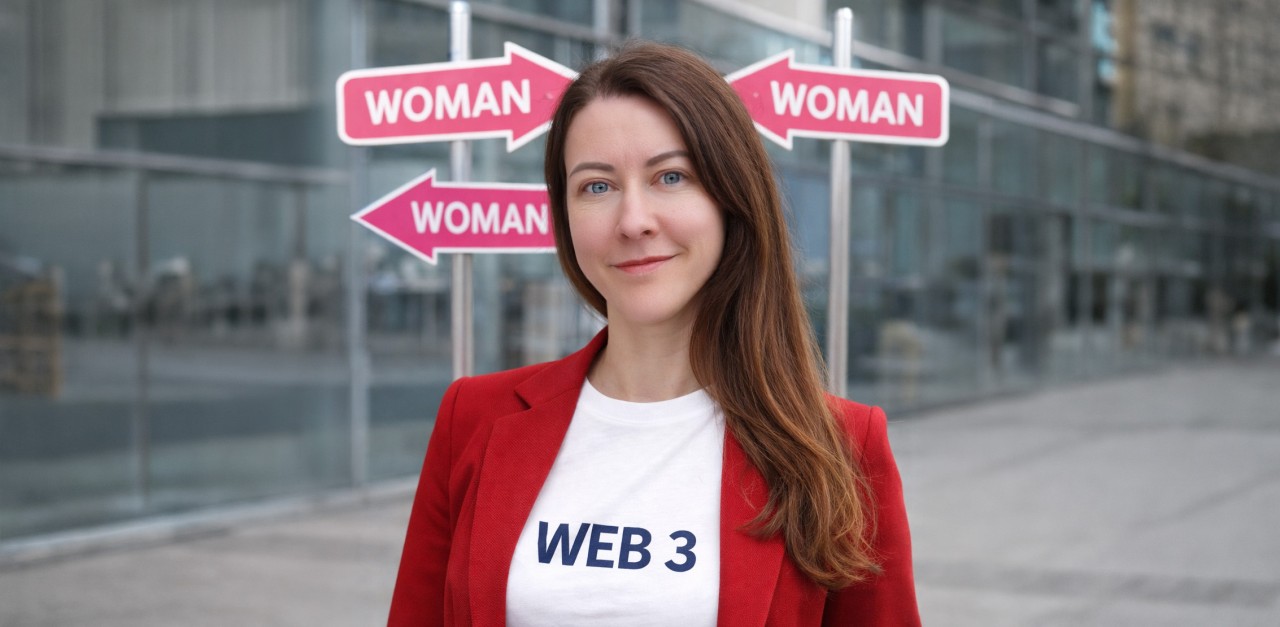

Linda Bucksey is clear eyed about both the promise and the limits of Web3. As founder and designer at LR Creative Studio, she has helped build an international business in a sector that still describes itself as open, meritocratic and decentralised, while often replicating the same concentration of power seen elsewhere in technology. Her view is neither cynical nor naïve. Web3, she argues, has created genuine new entry points for women, but progress still depends on persistence, visibility and access to the right networks.
Week 32 – Linda Bucksey, Founder and Designer at LR Creative Studio
Bucksey speaks about leadership in practical rather than ideological terms. “One thing for sure is that I am still learning,” she said. That is not false modesty. It reflects the operating conditions of the sector itself. “Web3 never sleeps. The industry is still evolving, and that brings a lot of uncertainty, so resilience and the right people by your side are crucial for survival.” In her account, leadership is not simply about authority. It is about building trust across cultures, time zones and disciplines, and doing so with consistency. “Trust, communication, and clarity are extremely important, especially when people are working across different cultures and time zones.”
That emphasis on reliability is important, particularly in an industry that still has a marked gender gap. Bucksey does not overstate the problem, but neither does she avoid it. “Sure, it’s male dominated and for women the start might be a bit slower, but persistence is key,” she said. Her point is straightforward. Web3 may like to see itself as a frontier sector, but it remains subject to familiar habits of recognition and influence.
The work still has to speak clearly. “No matter the gender, show up, do your best, and the right people will see your skill, knowledge, and reliability.”
That line between aspiration and reality runs through much of her thinking. Asked whether decentralisation is genuinely opening leadership opportunities for women, Bucksey was direct. “Honestly, leadership and capital are still largely concentrated in similar groups as in traditional tech. I’ve seen this firsthand.” It is a sharp observation, and an important one, because it cuts through the easy assumption that new technology automatically produces new power structures. Yet she is equally clear that Web3 has made room for people to enter in ways that traditional technology often does not. “Web3 has created new entry points that traditional tech doesn’t have. Think communities, open source contributions, and online networks.” For Bucksey, that is where the opportunity lies, but it only matters if those spaces are cultivated properly. “We just have to actively support inclusion, mentor others, and make sure different voices are heard.”
Her own experience of being challenged as a woman has, she says, been subtle rather than overt. “So far it has been challenged only very subtly,” she said, adding that some of it may have happened “behind my back where I haven’t really seen it”. Her response has been measured. “I stayed professional and confident. The right people will see past your gender.” There is no flourish in that answer, only a sense of discipline. What matters to Bucksey is not theatre but credibility. Looking ahead to her new venture, she expects those challenges may intensify, but her answer remains much the same. “I will focus on the work and the results. That’s what matters the most.”
In a sector built around trustless systems, Bucksey makes the point that trust between people still matters greatly. “People still build trust with people. Relationships still matter,” she said. Her own approach to leadership is rooted in communication and collaboration, and she is careful to distinguish long term relationship building from transactional networking. “I focus on building long term relationships rather than purely transactional ones.” That is more than good manners. It reflects the structure of the sector itself, where people move across projects, protocols and ventures with remarkable fluidity.
“More often than not, you might need to reach out to the same person again or work together on another project.” In that context, a reputation for seriousness and decency becomes a business asset.
One of the more useful aspects of Bucksey’s account is her insistence that women do not need to fit a narrowly technical mould in order to build meaningful careers in Web3. “Web3 companies still need marketers, designers, legal professionals, and many other roles,” she said. Her own route into the industry is a case in point. “I started with zero knowledge about Web3, equipped only with curiosity and my ninja like Photoshop skills.” That line captures something important about the sector at its best. Technical literacy matters, but curiosity matters too, as does the confidence to enter before every detail is mastered. Even so, Bucksey is not suggesting that non technical professionals can remain detached from the substance of the field. “My strong advice though is to understand what Web3 is about and have some basic knowledge.” Her advice is clear. “Build relationships early and stay curious. Don’t wait until you feel ready to participate.”
She is equally thoughtful about the role women can play as Web3 moves between informal communities and more formal regulatory or institutional settings. “To move between these worlds, you need to understand the language and priorities of each side,” she said. This is a mature view of leadership, one that recognises translation as a serious professional skill. Women, in her view, have an important contribution to make here, not because of any essential difference, but because the sector benefits from a broader set of instincts and perspectives. She points to “diverse perspectives, long term thinking, and a collaborative approach” as qualities that can help shape the future of the industry.
That becomes even more important as AI and blockchain increasingly intersect. For Bucksey, the governance questions surrounding those technologies are too significant to be left to a narrow circle. “As AI and blockchain start to cross paths, governance and ethics become even more crucial,” she said. The risk, if leadership remains homogeneous, is obvious enough. “Otherwise we risk embedding the same biases into the next generation of infrastructure.”
Her conclusion is measured but firm. Different voices need to be part of these conversations, “not just as participants, but as leaders helping shape the future frameworks.”
Bucksey also speaks plainly about support structures. Early on, she says, her strongest backers were male friends, largely because she did not know women in Web3 at the time. That was 2017, when the ecosystem was smaller and less connected. Since then, she has come to place much greater value on communities built around shared values and mutual support. Looking ahead, she wants to see “more mentorship, more networks connecting women across the Web3 ecosystem, and more funding opportunities for female founders”. That point is especially real for her now as she raises her first pre seed round.
What Bucksey offers, in the end, is not a manifesto but a practical account of leadership in a still emerging sector. Web3 may be technically new, but many of its professional realities are familiar. Credibility must be earned. Networks matter. Inclusion does not happen by accident. The women who lead in this space will do so not simply by entering it, but by shaping how it grows.
Three tips from Linda Bucksey
First, stay curious and keep learning. “The space changes quickly,” she said, so standing still is not a serious option.
Second, build relationships early. Participate in communities, connect with like minded people, and take the long view of professional trust.
Third, do not underestimate your perspective. As Bucksey puts it, “Diverse viewpoints are exactly what this industry needs as it matures.”
Related: Kaitlin Argeaux on theatre, ICOs, and the access gap in Web3


