


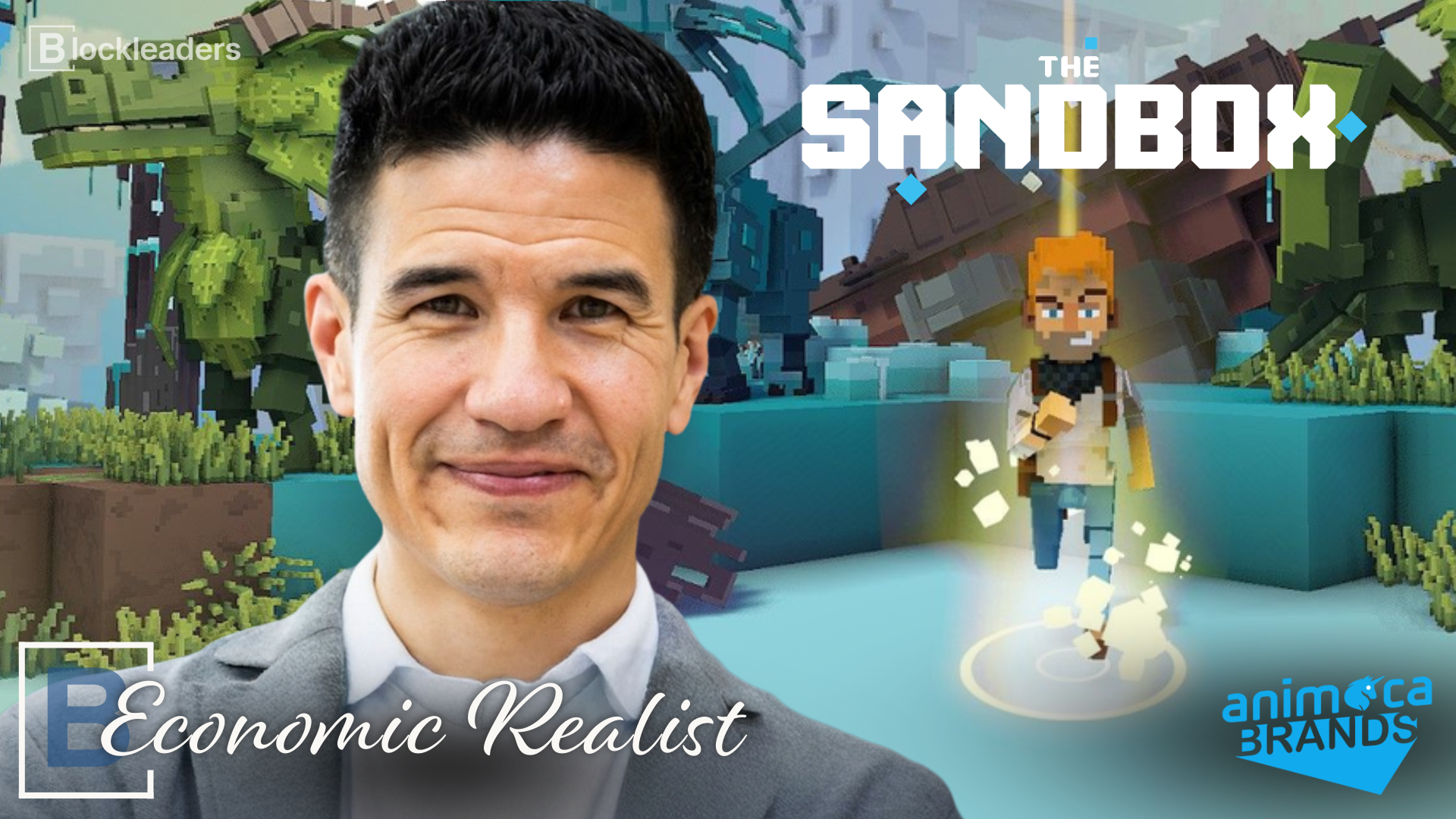

When Animoca Brands cut more than half of The Sandbox’s staff in August 2025, Robby Yung wasn’t signalling retreat. He was making a point. Now running both The Sandbox and Animoca’s investment arm, he argues Web3 gaming’s third era will be won on revenue per user, not raw user counts: a smaller, paying audience beats millions of mercenary wallets. It is the case for economic realism that the Reckoning Report calls the Great Recalibration, and the Sandbox is where he has to prove it.
Introduction
In August 2025, Animoca Brands let go more than half of the Sandbox’s roughly 250 employees, closed six international offices across Argentina, Uruguay, South Korea, Thailand, Turkey, and France, and removed co-founders Sebastien Borget and Arthur Madrid from operational roles [10]. The SAND token that had peaked above $8 in November 2021 was trading near $0.079, a 99% decline [14]. Into that wreckage stepped Robby Yung, until then Animoca’s CEO of Investments and a director on the Sandbox board, now the company’s chief executive. The man whose job had been reading more than 600 portfolio bets [7][17] was suddenly running its most distressed one.
What happened to the Sandbox was not one company’s bad year. It was the headline case of an industry-wide collapse that Blockleaders spent six months documenting in its Web3 Gaming Reckoning Report, an account of what became of blockchain gaming between 2019 and 2026 [5]. The findings were stark: 99% of the Web3 games surveyed lost their entire audience, 95% of gaming tokens fell from their highs, roughly 70% of the wallets the sector once counted as players were bots, and venture funding dropped 94.6%, from $5.4 billion in 2022 to $293 million in 2025 [5]. The Sandbox is one of the largest single names inside that data, and Animoca, the parent that built and funded it, is the most exposed individual investor across the same long tail [18]. By late May 2026 the distress had gone far enough that on-chain analysts flagged the United States government moving roughly $1.9 million in seized Alameda-linked altcoins, SAND among them, to Coinbase Prime, fresh selling pressure into a market with little left to absorb it [14].
The report did not end in obituary. It closed with cautious optimism and a line that reads as a challenge to everyone still standing: the age of speculation is over, and the age of building has begun [5]. Robby Yung was one of the people who answered that challenge on the record. In written commentary to Blockleaders in April 2026, he set out his own account of why the first two eras failed and what the third has to do differently [3]. This profile is the test of that account, because the executive who diagnosed the collapse from the investor’s chair is now the one being measured against his own diagnosis, at the most damaged asset he owns.
The Investor in the CEO Seat
Yung was the first CEO of Animoca Brands when it listed on the Australian Securities Exchange in 2015, and before that he co-founded the Hong Kong media company One Media Group and took it public on the Hong Kong Stock Exchange [11]. As Animoca scaled, he moved deliberately away from running the business. When Blockleaders’ Editor-in-Chief Jillian Godsil profiled him in November 2025, three months into the Sandbox job, he put it plainly: “I used to be CEO of the whole business. As we grew, it made sense to define roles more clearly. My focus has always been on investing and M&A rather than product building.” [7]
The portfolio he runs investments for is one of the broadest programmes in Web3. Co-founder Yat Siu took the chairman seat in 2020 to focus on investments [11]; Animoca acquired Sandbox developer Pixowl for US$4.875 million back in August 2018 [13], and by November 2025 the company’s chief strategy officer was citing 628 portfolio companies, of which only about 230 are gaming-related [17]. Gaming, the identity that defined Animoca through 2022, is now roughly a third of the bench; stablecoins, real-world assets, and AI-agent infrastructure are the new lines, anchored by the Anchorpoint Financial stablecoin joint venture with Standard Chartered and HKT [20]. The decentralised identity play, Moca Network, sits below Yung’s product surface and is Siu’s responsibility, not his. The real-world-asset programmes Jillian traced in November 2025 have continued through the first half of 2026 [7].
That is the seat the August 2025 restructure pulled him out of. A career investor, by his own description, was handed product responsibility for the asset whose collapse the whole sector watches. What he did next came directly out of what the portfolio had taught him.
Why the First Two Eras Broke
Yung’s account of what broke starts with the tokens themselves. Asked why so many play-to-earn tokens fell 95% from their highs [5][18], he does not blame the market:
“I am a big believer in games having fungible tokens, but I also think that creating a sustainable economy is not only difficult, but it requires a level of design expertise that most game studios do not possess, and the result is that many Web3 games didn’t survive the brutal reality of having their tokens freely-tradeable on public exchanges, where it’s the market, rather than the developer, that influences the price and volume.” [3]
Tokens are an economic instrument most studios lacked the staff to design. Jihoz Zirlin, co-founder of Axie Infinity and a contributor to the same report, reached the same conclusion from the founder side: Axie ran for two and a half years as a game before its AXS token launched, and most play-to-earn projects issued tokens long before they had any business doing so.
The second failure was spending. In a December 2025 interview with BlockchainGamerBiz, Yung named the discipline the boom skipped:
“They need to think about token rewards much more like cash UA spend, and this will help to avoid incentivising negative behaviour.” [2]
User-acquisition spend is among the most measured disciplines in the games business; a studio that spends $1 expects to know within thirty days what fraction comes back in lifetime value. The play-to-earn era issued token rewards as if they were free, assuming the speculative market would absorb the inflation. The April 2026 Caladan / ChainPlay report priced the assumption: $15 billion of capital burned, 300 named blockchain games shut down, 58% of GameFi venture firms booking losses between 2.5% and 99%, token values down 95% from 2022 peaks, with Animoca named directly among the most exposed investors [18].
The studios that survived inside his own portfolio learned the same lesson under fire. Pixels CEO Luke Barwikowski, whose farming MMO is an Animoca portfolio company [7][17], watched daily active users fall roughly 90% from a million-player peak [21] and now argues the metric that matters is Return on Reward Spend: whether a team brings in more value than it gives out [8]. Yung’s “token rewards much more like cash UA spend” is the same conclusion read back from across the cap table. The investor and the founder he funded arrived at one discipline from opposite ends of the drawdown.
“I did observe an overall tightening of the market. Less games were being funded, and this means less teams were coming together to try to build in the space.” [2]
Undesigned economies, unmeasured reward spending, and a funding winter that cleared the field: that is the autopsy of the first two eras, and it is the ground every claim Yung makes about the third has to stand on.
His Blueprint for the Third Era
The forward half of Yung’s commentary is where the diagnosis becomes a plan, and it starts by inverting the arithmetic the play-to-earn era measured itself by:
“A Web3 game with very high ARPU of $50 may only need 10K MAU to be financially viable compared to a Web2 mobile game with an ARPU of $0.02/month that needs 25M MAU’s.” [3]
Per-player monetisation two to three orders of magnitude above the free-to-play default changes the shape of the business: ten thousand committed players can carry the revenue that would otherwise require twenty-five million casual ones. Web3 studios that judged themselves against Web2 mobile MAU benchmarks were optimising against a yardstick that did not fit their economics. Mobile free-to-play, Yung points out, also loses 95% of its audience inside thirty days [3]. “Web3 games are not necessarily an outlier in gaming.” [3]
The second pillar inverts a decade of bot defence:
“I think game developers need to treat agents as new customer cohorts and decide how they want to serve them, rather than trying to turn them away. If an agent shows up at my game with money to spend in exchange for an experience, how is that any different to any other player?” [3]
The report estimates that roughly 70% of historical unique active wallets in Web3 gaming were bots [5]. The industry has treated that figure as a fraud problem for a decade. Yung’s argument is that with the agentic web now structurally inevitable, developers who design for and monetise agents as a customer cohort will beat developers who filter them out as contamination. His qualifier keeps the discipline attached:
“But for games with open economies, it will be as important as ever to design your token economy in such a way as to minimise cheating and unfair play, because these negatives will only be amplified if ‘bad’ agents are able to engage in these behaviours alongside ‘bad’ human players.” [3]
Animoca has put capital behind the same view. At Consensus 2026, Yat Siu argued the metaverse “isn’t a place” but a connective layer for fifty to a hundred billion AI agents, and announced a $10 million Animoca Minds development fund for AI-agent-native applications [19]. Yung’s agents-as-customers product logic and Siu’s fund are the same bet placed twice, once at the product layer and once at the capital layer.
Sandbox 3.0: The Blueprint in Production
Five weeks into the job, on 30 September 2025, Yung announced the plan that tests all of it: Sandbox 3.0, with three legs in mobile, infrastructure, and AI [1]. Each has since reached a specific, checkable state.
NEXT, the Sandbox’s first dedicated mobile battle royale, is built on Unreal Engine rather than Unity, the first non-Unity engine the company has touched in more than a decade [4]. Pre-registration opened 18 March 2026; the closed playtest ran 26 March through 5 April [6]. Two launch maps, Desert for long sightlines and City for vertical close-quarters play, support solo and up-to-twenty-player matches, and players carry identity, progression, and assets from the platform into the game. “Like our recent launch of WebGL games, NEXT is part of our plan to increase the reach of The Sandbox so players can discover, play and come back more often, whether they’re on desktop or on their phone.” [4] The engine choice is the load-bearing signal: reaching for a second engine is what a games company does when it wants the best tool rather than the familiar one.
SANDchain, the Layer 2 creator-economy network, launched its testnet on 14 October 2025 [1] and closed Phase 1 in April 2026 with 6.9 million transactions across 310,000 accounts; 203,000 wallets signed the manifesto, participants completed 948,000 quests, 2,600 builder projects registered, and 35 partners were named [15]. BlockchainGamerBiz’s coverage attached the honest caveat: the pattern is consistent with airdrop farming, the same inflation that distorted many 2024-2025 testnets, rather than organic creator demand [15]. Mainnet is scheduled for 2026 with no public date, and the token-bonding-curves layer announced at launch is not yet live [1].
On AI, Yung has been explicit: “AI will revolutionize this space and we plan to lead the charge.” [1] The Rosebud AI partnership for vibe-coded games and custom asset-generation models are the concrete deliverables; asset generation is the lever that scales [1].
The honest baseline under all three legs: the eight million registered users Yung cited at launch are cumulative platform registrations [1], while the on-chain daily active wallet count runs closer to four to five thousand [14]. Sandbox 3.0 is a reset, not a victory lap, and Yung’s own UA-spend and ARPU arguments are the standards it will be measured against.
The Nasdaq Window
The turnaround is running against a clock. Animoca’s long-planned Hong Kong listing, its reported public-markets path through 2024, is dead, and the route now runs through New York. On 4 November 2025, Animoca and Currenc Group, a Nasdaq-listed fintech, signed a non-binding term sheet for a reverse-merger that would hand Animoca shareholders approximately 95% of the combined entity [16]. Valued at $1 billion at announcement, the implied combined valuation had drifted to approximately $8.7 billion by May 2026 on CURR’s share price [16]. The exclusivity period was extended on 6 May 2026 to 30 June 2026, with a Q3 2026 closing target, a 31 December 2026 long-stop date, and the freedom for either party to walk [16].
If the deal closes, Animoca becomes a Nasdaq-traded public company within months, and the Sandbox turnaround becomes the most visible product story it carries into the listing. The four ideas Yung has put on the public record, token rewards as UA spend, the ARPU inversion, agents as customers, and AI-native production, become the story the public market reads alongside the ticker.
What Yung Has to Prove
The building the report called for now has a concrete test case, and it is Yung’s. Over the next twelve months he has to turn NEXT from a closed playtest into a live game with enough retention to lift the Sandbox above its four-to-five-thousand-wallet floor [14]; get SANDchain to mainnet with creator activity that reads as real rather than as airdrop farming [15]; and see the Currenc merger close by its 30 June deadline [16]. None of the three is assured, and all three are the standards he set for everyone else.
His own forecast carries the same guarded optimism the report ends on:
“In 2026 we should see a return of ‘alts’ which, of course, includes game and game infrastructure tokens.” [2]
The stakes cut both ways. If the Sandbox recovers, Yung becomes the case that Web3 gaming’s third era is real: the investor who watched the first two fail from the cap table, then rebuilt the most broken asset he owned into a working example of what comes next. If it does not, the same research that named Animoca among the sector’s most exposed investors [18] will have a sequel, and his turnaround will be a line in it. The play-to-earn boom built the market before the game. Robby Yung has put his name on reversing that order, and the Sandbox is where it gets settled.
About This Profile
This article is part of the Architects of the Future series by Blockleaders, the companion to Editor-in-Chief Jillian Godsil’s November 2025 profile of Yung ^7]. The direct quotes attributed to Robby Yung were drawn from his written commentary provided to Blockleaders on 2026-04-23 in response to the [Reckoning Report questionnaire, his December 2025 interview with BlockchainGamerBiz, and the September 2025 Sandbox 3.0 announcement. Specific facts on the current state of the Animoca portfolio, the Currenc Group reverse-merger, the SANDchain Phase 1 testnet, and the Caladan / ChainPlay April 2026 industry report were collected during fresh research for this article in June 2026; every claim is footnoted to its source inline.
Blockleaders Archetype: Investor | Publisher Robby Yung is classified as an Investor under Blockleaders’ leadership taxonomy: a CEO of Investments responsible for capital allocation across more than 600 portfolio companies. His secondary archetype is Publisher: an executive responsible for one of the largest consumer surfaces in the portfolio, where investment discipline now informs product decisions on an asset in distress.
Read the full report: Web3 Gaming: The Great Reckoning, 2019 to 2026
Sources
- The Sandbox 3.0 announcement and platform statistics. CryptoPotato. “The Sandbox CEO Robby Yung Unveils Vision with New AI, Web3 and Mobile Initiatives.” 2025-09-30. https://cryptopotato.com/the-sandbox-ceo-robby-yung-unveils-vision-with-new-ai-web3-and-mobile-initiatives/
- BlockchainGamerBiz. “2026 Trends: The Sandbox’s Robby Yung says think of token rewards much more like UA spend.” 2025-12-17. https://www.blockchaingamer.biz/features/interviews/41215/2026-trends-sandbox-robby-yung-token-rewards-much-more-like-ua-spend/
- Robby Yung’s written contributor responses to the Blockleaders Reckoning Report questionnaire, received 2026-04-23 via warm introduction from Editor-in-Chief Jillian Godsil. All quotes are verbatim from his written submission to Blockleaders.
- Animoca Brands. “The Sandbox opens pre-registration for NEXT mobile playtest built on Unreal Engine.” 2026-03-18. https://www.animocabrands.com/announcement/the-sandbox-opens-pre-registration-for-next-mobile-playtest-built-on-unreal-engine
- Sawyer, D. (2026). “Web3 Gaming: The Great Reckoning.” Blockleaders. https://blockleaders.io/web3-gaming-reckoning-report/ Sector-arc statistics (99% audience loss, 95% token declines, 94.6% VC funding collapse), the ~70% historical bot-wallet estimate, and the report’s closing outlook (“cautious optimism”; “the age of speculation is over; the age of building has begun”).
- BlockchainGamerBiz. “The Sandbox’s mobile battle royale game NEXT starts playtest on 26 March.” 2026-03. https://www.blockchaingamer.biz/news/41919/the-sandbox-mobile-battle-royale-game-next-playtest-26th-march/
- Godsil, J. (2025). “Robby Yung: Connecting the Dots in Web3.” Blockleaders, by Editor-in-Chief Jillian Godsil. 2025-11-04. https://blockleaders.io/robby-yung-connecting-the-dots-in-web3/ Includes Robby’s verbatim self-description on his role at Animoca; the Animoca portfolio scale as of that date; Sebastien Borget’s transition to global ambassador.
- BlockchainGamerBiz. “2026 Trends: Pixels’ Luke Barwikowski says the only way to save crypto gaming is to not build for crypto gamers.” 2025-12-24. https://www.blockchaingamer.biz/features/interviews/41204/2026-trends-pixels-luke-barwikowski-only-way-save-crypto-gaming-not-build-for-crypto-gamers/
- CoinDesk. “Metaverse Platform The Sandbox Cuts 50% Staff, Restructures as Animoca Brands Take Control.” 2025-08-28. https://www.coindesk.com/business/2025/08/28/the-sandbox-cuts-50-staff-restructures-as-animoca-brands-take-control Confirms 50%+ headcount cut from ~250 employees, closure of six international offices (Argentina, Uruguay, South Korea, Thailand, Turkey, Lyon), removal of Borget and Madrid from operational roles, and Robby Yung’s appointment as CEO of the Sandbox.
- Cointelegraph Magazine. “Journeys: Robby Yung on Animoca’s Web3 investments, TON and the Mocaverse.” https://cointelegraph.com/magazine/robby-yung-animoca-web3-investments-ton-mocaverse/
- Animoca Brands. “Animoca Brands acquires Pixowl, developer of The Sandbox game for mobile and blockchain.” 2018-08-27 (ASX release). https://www.animocabrands.com/animoca-brands-acquires-pixowl Plus GamesBeat coverage of the US$4.875 million deal at https://gamesbeat.com/animoca-brands-acquires-sandbox-game-developer-pixowl-for-4-875-million/
- SAND token price history via CoinMarketCap: https://coinmarketcap.com/currencies/the-sandbox/ SAND May 2026 price (~$0.079) versus November 2021 peak ($8.40), a 99% decline, with virtual-land values down more than 95% from 2021 peaks: BYDFi analysis, https://www.bydfi.com/en/cointalk/sandbox-sand-price-2026-analysis On-chain daily-active-wallet data (~4,500 DAU) via DappRadar: https://dappradar.com/dapp/the-sandbox Late-May 2026 transfer of roughly $1.9 million in seized Alameda-linked altcoins (RNDR, UNI, SAND, MASK, AXS) to Coinbase Prime, first flagged by Arkham Intelligence: BeInCrypto, https://beincrypto.com/us-government-alameda-altcoins-coinbase-prime/
- BlockchainGamerBiz. “SANDchain successfully completes Phase 1 testnet.” 2026-04-16. https://www.blockchaingamer.biz/news/42083/sandchain-successfully-completes-phase-1-testnet/ Phase 1 totals: 6.9M transactions, 310k accounts, 203k manifesto signers, 948k quests completed, 2,600 builder projects, 35 named partners. The coverage cautions that, given participants’ hopes of future financial reward, the activity pattern is more consistent with airdrop farming than organic creator demand.
- Currenc Group. “Currenc Group announces extension of exclusivity period for proposed reverse merger with Animoca Brands Corporation Limited.” GlobeNewswire, 2026-05-06. https://www.globenewswire.com/news-release/2026/05/06/3288764/0/en/currenc-group-announces-extension-of-exclusivity-period-for-proposed-reverse-merger-with-animoca-brands-corporation-limited.html (exclusivity extended to 30 June 2026; Q3 2026 closing target; 31 December 2026 long-stop). Deal structure and implied valuation (Animoca shareholders ~95% of combined entity; ~$8.7 billion implied versus $1 billion at announcement): BlockchainGamerBiz, https://www.blockchaingamer.biz/news/42197/animoca-brands-nasdaq-listing-nominally-valued-8-billion/
- Cointelegraph, reporting Animoca Brands’ chief strategy officer (November 2025): 628 portfolio companies, of which about 230 are gaming-related, with new focus verticals in stablecoins, RWA, DePIN, DeFi, and AI. https://cointelegraph.com/news/animoca-brands-gaming-stablecoins-ai-depin-investments
- Caladan / ChainPlay industry report. “Web3 gaming: $15 billion burned.” April 2026. Coverage at https://www.coindesk.com/markets/2026/04/23/more-than-90-of-web3-games-failed-after-usd15-billion-boom-as-gamers-never-showed-up-caladan and https://beincrypto.com/web3-gaming-projects-dead-caladan-report/ The report names Animoca directly among the leading investors exposed across the long-tail attrition figures.
- CoinDesk. “Animoca Pivots From Virtual Worlds to an AI-Driven Metaverse at Consensus 2026.” 2026-05-07. https://www.coindesk.com/markets/2026/05/07/animoca-pivots-from-virtual-worlds-to-an-ai-driven-metaverse-at-consensus-2026 Yat Siu keynote: the metaverse as a connective layer for fifty to a hundred billion AI agents; announcement of the $10 million Animoca Minds development fund.
- The Block. Animoca Brands’ 2026 strategic pivot into stablecoins and real-world assets, including the Anchorpoint Financial joint venture with Standard Chartered and HKT. https://www.theblock.co/post/380756/animoca-brands-stablecoin-rwa-2026
- Pixels daily-active-user trajectory: 1 million DAU at peak (The Block, https://www.theblock.co/post/294058/crypto-video-game-pixels-says-it-hit-1-million-daily-active-users) declining to 109,000 paying daily active wallets by December 2024 (GAM3S.GG, https://gam3s.gg/news/pixels-109k-dauws-december/).


