

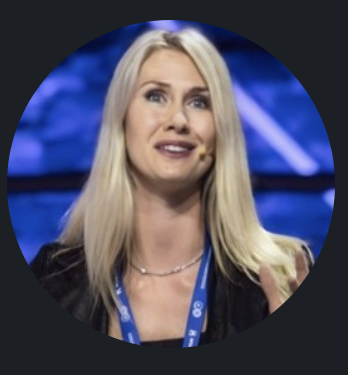

Alexandra Overgaag, founder and CEO of Thrilld Labs, does not spend much time dwelling on the gender imbalance in technology. While she acknowledges that Web3 remains heavily male dominated, her focus is firmly on building products, growing a business and delivering results.
Overgaag leads a global team and has developed her approach to leadership over time. Rather than subscribing to a predefined model, she believes leadership evolves according to individual strengths, preferences and the needs of the people around us.
“Leadership, for me, has grown over time and it will never be perfect,” she says. “There will always be challenges.”
Some of those challenges stem from external factors such as fundraising setbacks, product delays or slower-than-expected traction. Others come from internal doubts. Looking back, Overgaag believes many of the uncertainties she experienced originated from her own perceptions, sometimes reinforced by external events and criticism. Yet she has come to recognise that most challenges can be overcome.
Although discussions about female leadership often focus on barriers, Overgaag prefers to concentrate on what needs to be achieved. Success, she believes, is ultimately demonstrated through impact and results.
Web3 is frequently described as a meritocratic environment, and Overgaag agrees with that characterisation. From an end-user perspective, she sees an industry that provides opportunities to people regardless of background. As someone trained as both a lawyer and political scientist, without deep connections in traditional finance or established business circles, she has built a technology company, raised capital and created products serving professionals across the sector.
At the same time, she observes that as the industry matures and becomes increasingly intertwined with traditional institutions, familiar power structures begin to emerge.
“The more we move up the chain of command within the ecosystem, in terms of power, deals and leadership positions, we see traditional plays and games being replicated,” she says.
That evolution may be understandable, but it does not necessarily make it desirable.
Being a woman in the sector brings both opportunities and challenges. Overgaag notes that her authority is regularly questioned, whether during online meetings, at conferences or through public commentary on social media and video platforms.
Such experiences once frustrated her. Today, they tend to provoke amusement rather than anger.
At industry events she frequently encounters assumptions and biases, often expressed casually rather than maliciously. Her preferred response is not confrontation but awareness. A well-placed joke or a light-hearted comment can often achieve more than direct criticism.
As a conference moderator and MC, she sometimes notices language that unconsciously excludes women. Rather than ignoring it, she addresses it briefly and publicly. In doing so, she hopes to make people more aware of their assumptions while also ensuring women in the audience feel acknowledged.
That approach extends to her own team. Creating an environment where women feel empowered and ambitious is important to her, particularly in a sector where female leadership remains relatively uncommon.
Trust remains one of the most intriguing contradictions within Web3. While blockchain technology is often described as trustless, Overgaag argues that businesses are still built by people, making trust an unavoidable factor.
People decide whom to trust based on many factors: behaviour, reputation, experience and track record among them. Gender forms part of identity, but Overgaag does not believe it defines her leadership style.
Instead, she points to a much broader range of influences. Years spent working as a bartender while studying taught her how to engage with people. Her education shaped her analytical thinking. Her Dutch background, mixed with Italian influences, contributed to her outlook. Humour plays a role too, alongside a serious commitment to the business itself.
These experiences collectively influence how she builds relationships and grows networks.
One initiative arising from that perspective is EcstaSHE, a female business group developed through Thrilld Labs. The aim is practical rather than symbolic: creating opportunities for women to share deals, contacts and professional opportunities.
For women considering a career in Web3, Overgaag believes the barriers to entry have never been lower. Artificial intelligence tools, large language models and no-code development platforms have dramatically expanded access to technical capabilities.
However, easier access also means greater competition.
Her advice begins with clarity of purpose. Someone seeking a job should identify companies they find interesting and start there. Entrepreneurs should focus on product-market fit and recognise that building successful products usually requires collaboration. Investors need to think carefully about how they intend to outperform the market.
Despite founding a technology company, Overgaag does not come from a technical background. She freely admits that when she started, she knew very little about software development.
“I was not a technical founder,” she says. “I still do not code because we have people who do it much better, but I learnt so much about the technology.”
Her conclusion is straightforward. Anyone can enter Web3, provided they are willing to begin, make mistakes and remain determined.
The industry itself continues to evolve. Overgaag observes a growing divide between grassroots crypto communities and more institutional participants entering the sector. Some remain strongly attached to particular ecosystems or technologies, while others approach blockchain through the lens of traditional finance.
Rather than choosing sides, she prefers to work with people building worthwhile projects regardless of their background.
Overgaag sees a similar dynamic emerging in discussions around artificial intelligence and blockchain. Having once hoped to pursue doctoral research into AI governance, international law and democratic institutions, she was surprised to find little academic interest in the subject when she applied years ago.
That experience ultimately pushed her towards Web3.
Today, she remains enthusiastic about the convergence of AI and blockchain technologies while maintaining a healthy scepticism about long-term value creation. Governance frameworks have a role to play, but she believes there is often a gap between those discussing governance and those actually building systems.
For that reason, meaningful oversight requires more than policy discussions. It requires code auditing, explainability and broader participation in the creation of technology itself.
More women, and more people from different regions and backgrounds, should be involved in building and coding these systems, not simply debating them afterwards.
Reflecting on her own journey, Overgaag credits much of her progress to the people she encountered along the way. Investors backed her ideas. Friends became business partners. Team members joined from around the world.
Not every experience was positive. Some relationships resulted in broken trust and setbacks. As a lawyer, she remains a strong believer in contracts and legal protections. Yet she also believes progress depends on individual initiative.
While many advocate for new funding mechanisms, grants and support structures for women, Overgaag ultimately places greater faith in personal agency.
If opportunities do not exist, her instinct is simple.
Build them.
Three Tips for Young Women Entering Web3
- Focus on purpose, not leadership
“Becoming a leader might be an inherent side-result of your efforts, but it should not be the goal. The goal should be related to something that keeps you up at night, something that makes you have a drive to succeed.”
- Prepare for setbacks but aim high
“If you are becoming a leader or you are leading a team, company, or even your own efforts, know that not all the results depend on you only. You’ll face challenges and rejections, including people hurting your trust. Always assess the worst that can happen, but aim for the best.”
- Be kind and build relationships
“Be nice to others and yourself. We only live once. Let’s build together, network, move on from the sob stories, and have some good times.”