


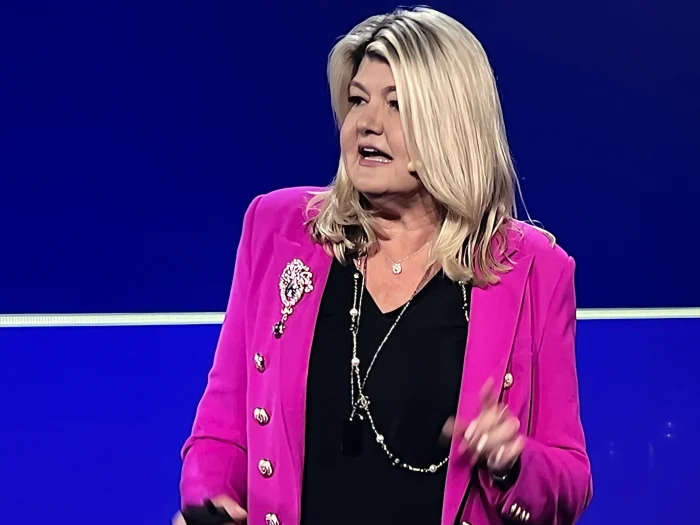

Sandy Carter, COO of Unstoppable Domains and author of “AI First, Human Always” isn’t just talking about the future of the internet, she’s helping build it. With a career that has spanned leadership roles at IBM and Amazon, Carter now finds herself at the forefront of Web3, guiding how digital identity, AI, and privacy evolve in tandem.
Sandy Carter, COO of Unstoppable Domains and author of “AI First, Human Always,” explains her career: “I started at a startup, went to IBM, then back to startups, then Amazon, and now I’m here again,” Carter says. “That rhythm taught me something: you need both structure and disruption to lead through change.”
Carter is no stranger to disruption. At Amazon, she worked on cloud services and evaluated blockchain opportunities before most had even wrapped their heads around decentralized tech. But it wasn’t Bitcoin that drew her in.
“For me, blockchain started with enterprise use cases,” she says. “Supply chains, financial ledgers, hospitals using it for logistics. That’s where it clicked.”
Now, as CEO of Unstoppable Domains, Carter is focused on one thing: giving people ownership of their digital identities.
“We started with a simple premise,” she explains. “Replace crypto wallet addresses with something human-readable. Just like we used to type IP addresses before URLs. Today, we resolve between 10 and 30 million domain queries a day.”
The recent launch of the .privacy domain has been a breakout success, the fastest-selling TLD ever on the Base blockchain. Within 24 hours, 1,000 domains were claimed. Carter attributes the success to rising public awareness. “Privacy isn’t a feature anymore. It’s a necessity,” she says.
The .privacy domain isn’t just a catchy name; it’s a statement of intent. It integrates encrypted communication, decentralized identity, and over 200 cryptocurrencies. More importantly, it offers users full control over what they share and with whom.
“I want privacy where I own the data, and I decide who sees what, for how long, and for what purpose,” Carter says. “Blockchain gives us that foundation, but we need to layer confidentiality on top of it.”
The initiative is supported by Women in Web3 Privacy, a nonprofit collective championing privacy-first tools and education. Carter sees this as both a technological and cultural movement. “This is about digital sovereignty. We’re not just building products. We’re empowering people.”
That same philosophy runs through her book, “AI First, Human Always.” A field guide for business leaders navigating the age of superintelligence, it breaks down seven macro-trends in AI, from tokenization to multimodal agents, while offering a very human take on leadership.

“AI is moving fast, and leaders need to speak its language,” Carter says. “But the point isn’t to compete with machines. It’s to lead with emotional intelligence, ethics, and creativity.”
The title isn’t just catchy; it’s a mission statement. Carter believes in the symbiosis of man and machine.
“Yes, some repetitive tasks will be automated. But we move up the stack. Strategy, gratitude, emotional intelligence, those are human.”
She references the World Economic Forum’s forecast: 170 million jobs created, 92 million displaced, and over a billion that will require AI fluency. “The middle of the job market, that’s where AI will augment rather than replace. It’s a huge opportunity.”
For AI First, Carter reveals she integrated AI agents to accompany book readers.
“When you buy the book, you get an AI agent trained on it. And I keep training her so she stays current. It’s the only way to keep up.”
Asked about gender in Web3, Carter doesn’t hesitate. “We need diversity of thought,” she says. “Not just gender or race. Even the same university can create identical thinkers.”
She founded the Unstoppable Women of Web3 and AI Hub to address this gap. Today, the group has trained over 55,000 women and partnered with 220 organizations.
“It’s not just a pipeline issue. It’s about creating safe, empowering spaces.”
Legacy, for Carter, is not just about building tech. It’s about building people.
“I want to be remembered as someone who reached back and helped others go further,” she says. “And someone who helped people understand how to use technology to create impact. Not just build it.”
With privacy breaking sales records, AI redefining how we work, and decentralized identities gaining traction, Carter is shaping the next era of the internet, one where people don’t just use technology. They own it.


