


This week is Mental Health Awareness Week and it got us thinking about the potential of the metaverse to dissect our woes, escape from depression and express our struggles in the real world.
Last week I stumbled upon an interactive small collection of NFTs titled Imok with the subtitle ‘I am not ok but that’s ok’. This one line of thought summarizes the thinking behind many of the struggling creators and artists who provide underlying meaning and drive awareness of mental health issues through their art.
I like zombies more than living things.. https://t.co/KrED9860oc
— 🍅I'mOK (@ogunkizmaz) May 8, 2023
This little detour into the world of art expressing mental illness led me to the Imok gallery in On Cyber. It was there that time could be spent observing, not digesting the true spirit of the artwork. It was this virtual space that allowed for the freedom to explore how digital artists are using the metaverse to express the complexities of the human mind.

Artists, Mental Health, and Creative Exploration
Using art as a way to express our inner feelings is nothing new. Throughout history, artists have fearlessly depicted mental suffering, forging a connection between the realms of art and mental health.
From the iconic works of Vincent van Gogh and Edvard Munch to contemporary artists, artists have courageously depicted their own mental health struggles and it has often been a recurring theme in their work. These artists opened the doors for discussions on mental health, emphasizing that creativity can stem from the depths of human experience.
However, virtual spaces and communities have provided new mediums for approaching mental health awareness.
Web3 Communities: A Sanctuary of Understanding
Amidst the challenges of discussing mental health openly, virtual communities have become invaluable spaces of solace for artists. Metaverse platforms have enabled individuals to connect with like-minded peers.
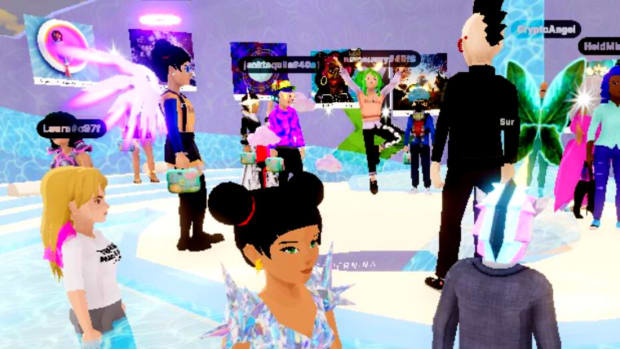
There are many ways that people today are using metaverse spaces. We popped into some of the dedicated Twitter spaces and Decentraland as they hosted a ‘Joy of Missing Out’ aka JOMO exhibition featuring 40 artists.

Web3 creators are exploring virtual cities and upskilling in Upland, escaping to the gamified world of The Sandbox, discovering digital art collectors in On Cyber, participating in poker tournaments in Decentraland and designing products for our virtual lives in Neoki.
Not only are these communities tapping into a shared understanding of the creative struggles faced by artists, they also allow collectors to enjoy the narratives of their collections, including community members in ongoing events, campaigns and opportunities to see their art in different ways.
Mental illness is often accompanied by a sense of isolation, with many sufferers unable to face the demands of social norms and everyday interactions. The anonymity provided by the metaverse creates a safe environment for those who are vulnerable.
Collaboration and Connectivity as two key ingredients
The collaborative nature of the Metaverse enables artists to merge their talents and push the boundaries of creativity.
Using NFT collections, artists and platforms can pool resources, skills and perspectives to create unique environments for communities to connect. A great example of this was with the Jackie Tsai collection in Upland where the community could decorate their homes in Jackie Tsais ornaments for Halloween.
For Lindsay Anne Aamodt, Head of Marketing at Upland Metaverse, “The power of the collective is harnessed in Web3 through the shared values of communities.”
Speaking with Aamodt, one of the Upland users summarizes the joy of the metaverse well, saying that “meeting people is therapeutic in a virtual world and we do it better than in the real world.” He points to the shared vision for success, rather than an individualistic approach. It is beneficial for the entire community to life each-other up and be helpful.
These interactive displays not only inspire the artist but bring active communities into the creative process, giving them a say in how their artwork is displayed to the wider public. Think about the art on your walls at home today. How would you show it off to the world? With the metaverse, now you can.
The Metaverse and NFTs Redefining Artistic Expression
As technology propels us forward, the Metaverse presents a frontier of unbounded creativity for artists. Within these virtual environments artists are liberated from physical constraints and presented with new ways to showcase their work.
They are also provided with a new level of ownership over the creative process, the distribution of their artwork and have a closer connection than ever before with their collectors.
“Artists now have an opportunity to transcend physical limits and use their imaginations in ways that may have previously been unimaginable. At Neoki, we are passionate about forging connections between designers, in the real world and redefining design of virtual environments. Seeing collaborations come to life empowers artists to be their creative selves,” says Zara Zamini, Co-Founder of Neoki Metaverse.
Zamani notes that “Neoki are closing the loop of physical to virtual and virtual back to physical, enabling brands and artists to bring their creations from the virtual world into physical reality.”
The Metaverse allows for the creation of multidimensional, interactive experiences, combining visual art, sound, animation, and interactivity. Through this new realm artists can translate their experiences of mental health into immersive experiences that engage new audiences.
With the continued innovation in the blockchain space, art is evolving to foster new ways of destigmatizing mental health struggles and placing community at the heart of everything.