


Week 5 – Sandy Carter COO of Unstoppable Domains
As Web3 continues to redefine the architecture of the internet, finance, and governance, it brings with it the rare opportunity to rebuild systems from the ground up. But if we are to build better, fairer, more inclusive systems, we must actively spotlight, and support, women in leadership roles.
Historically underrepresented in both tech and finance, women leaders bring diverse perspectives, collaborative approaches, and often values-driven leadership that prioritizes long-term sustainability over short-term gain. In Web3, where decentralized decision-making, community building, and innovation are core tenets, this diversity of style is very welcome if not essential.
Leadership isn’t monolithic. While traditional models have often emphasized hierarchy, competition, and control, many women leaders bring alternative approaches: participatory, empathetic, consensus-driven, or mentorship-focused. These styles align naturally with the ethos of decentralization and trustless systems, offering a counterbalance to purely technocratic or profit-led strategies.
By highlighting women in Web3 leadership, founders, developers, policymakers, and community builders, we not only correct representation gaps but also signal to the next generation that there is no single path to power. Visibility shapes possibility. And in a space as fast-moving and foundational as Web3, ensuring a plurality of voices isn’t just ethical, it’s strategic.
For the next 12 Mondays we are going to bring you some of the most inspiring women in Web3 and explore how and why they think as they do.
Week 5 – Sandy Carter on Women’s Leadership: Building New Futures, Not Replicating Old Patterns
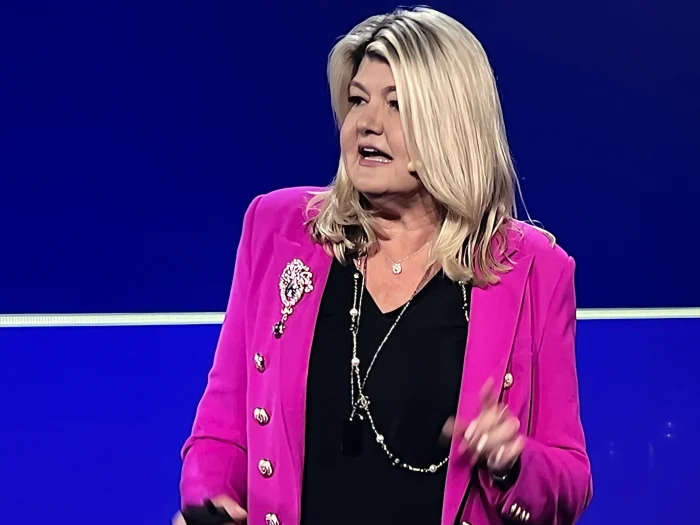
Sandy Carter is clear-eyed about the promise and the pitfalls of AI and Web3. Both, she argues, can democratise access and flatten hierarchies but only if designed with intent.
“Web3 can flatten hierarchies. AI can remove bias. But only if we program them with new intentions. Otherwise, we risk replicating old structures in new wrappers.”
Carter points to her work with Unstoppable Women of Web3 and AI, a community she founded to bring more women into the space. For her, some of the most impactful projects have been led not by engineers, but by women in go-to-market roles including storytellers, brand builders, and community leaders. Related: Tara Annison on technical curiosity and Web3 authority.
“In fact, some of the most successful AI projects I’ve seen were elevated not by engineers, but by incredible go-to-market women who understood positioning, trust, and scale.”
She has also encountered the familiar challenge of being overlooked in professional settings. She recalls one pitch where questions were directed to her male colleague despite her leading the deal.
“I leaned in and said, ‘I built the strategy. Let me walk you through the customer journey and monetization model.’ That shifted the entire conversation.” She calls this idea “voice equity” as the ability to show up fully and be heard in spaces where women may be underestimated. “As women, we don’t just show up, we reframe the rules.”
Trust in a Trustless World
Web3 is often described as “trustless,” and AI as “probabilistic.” For Carter, that makes human leadership more important, not less.
“While the tech operates on logic, the adoption runs on trust. Whether I’m launching an AI-powered domain or a digital identity platform, my approach is deeply human: educate first, communicate clearly, and build bridges.”
Being a woman in this environment, she believes, helps her lead with both empathy and precision. “People don’t just buy what you do, they buy why you’re doing it. That’s a go-to-market truth in any era, but it’s especially vital in AI and Web3 where the fear factor can be real.”
Although she is not an engineer by training, Carter has led some of the most impactful AI and blockchain initiatives of recent years. Her background in sales, marketing, and business development has become a strength. “You don’t have to code it to change it,” she says. “I bridge builders with users, platforms with adoption, vision with execution.”
Crossing Boundaries, Setting Standards
One day Carter might be on a DAO call full of emojis and experimental governance; the next she is briefing Fortune 100 executives. Navigating these worlds requires adaptability, but not compromise. “I’ve learned to adjust my framing, but never my values,” she says.
That ability to cross boundaries also extends to governance. She is adamant that women must play a central role in AI and Web3 governance.
“Governance is where values become systems. If women aren’t at the table, those systems won’t reflect us.”
Carter credits mentorship and community for her own career.
“I remember my first Web3 pitch, it was a disaster. But other women in the room pulled me aside afterward and said, ‘You’re onto something. Refine it and try again.’ That belief was everything.”
This experience inspired her to launch Unstoppable Women of Web3 and AI, which she describes as a space not just to celebrate wins but to share frameworks, introductions, and real-world advice.
“What we need next? Funding for first-time founders. Executive tracks for non-technical women. And more visible wins by women in go-to-market, not just engineering.”
Three Principles for the Next Generation
When asked what advice she would give to young women looking to lead in AI and Web3, Carter distils her experience into three principles:
- Define Your Superpower – Whether it’s storytelling, legal, operations, or partnerships, own it—and lead with it.
- Learn the Tech Enough to Lead the Strategy – You don’t need to write Python, but you do need to understand AI agents, LLMs, or wallets well enough to guide adoption.
- Build Before You’re Ready – Don’t wait for the title. Join communities. Launch an experiment. Mentor someone else. Leadership starts before the spotlight.
Sandy Carter’s leadership blends precision with empathy, strategy with community. She is determined that the next phase of AI and Web3 will not just replicate old systems in new code. Instead, she sees a chance to embed inclusivity, trust, and human values at the heart of technological adoption.
“AI First, Human Always isn’t a slogan,” she says. “It’s a responsibility.”
Related: Candice Teo on PR for institutional Web3


