


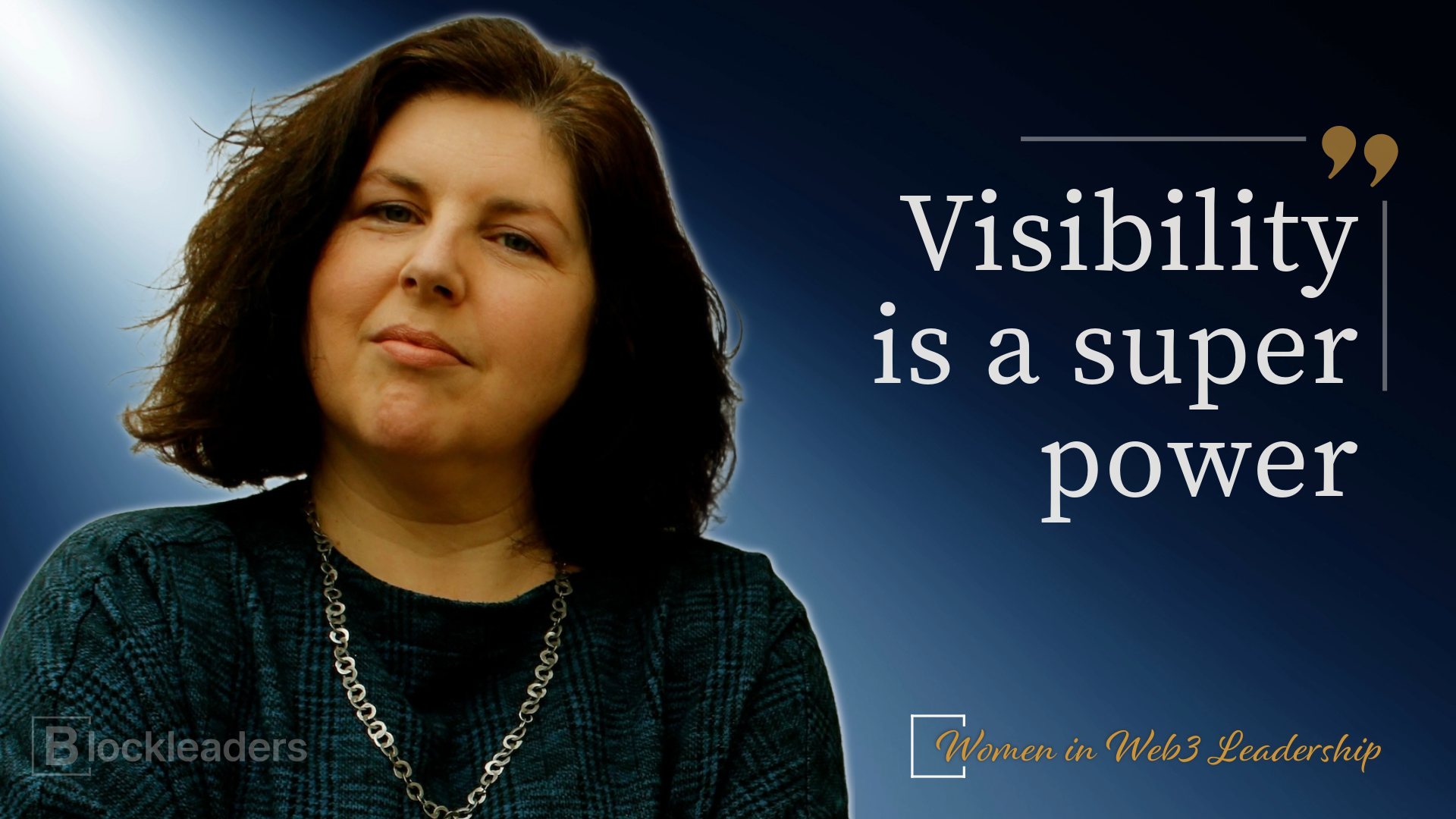

Fiona Delaney is the co founder of Origin Chain Networks. Her leadership philosophy is focused and strategic, built around resilience and sustainability in infrastructure and ecosystems, the work that tends to matter most when the market is no longer forgiving. Delaney described it as solving problems that make a difference, even when that looks unglamorous to those chasing short-term returns.
Week 29 – Fiona Delaney, co founder of Origin Chain Networks
Delaney leads a global team and frames decentralised management as a discipline rather than a slogan. The lesson, she said, has been not to micromanage. “Our team is diverse, driven and delivery-oriented. We set our rules, choose tools, and execute.”
That directness runs through her view of leadership as a woman in a sector that still skews male. Delaney does not romanticise the idea that decentralisation automatically removes bias.
“Systemic issues do not disappear just because someone gets into crypto or AI.” She also treats the moment as an opportunity. The ambition is not to wait for permission, but to build credibility through work, presence, and long-term thinking.
Where Web3 rhetoric often leans on meritocracy, Delaney offers a more analytical framework. She described a personal equation for decision making and leadership, designed to make the components visible rather than mysterious.
“Decision equals opportunity plus confidence times extroversion divided by risk appetite.” The equation is not gendered, she noted, but the inputs often are. In Delaney’s view, confidence can be built, and risk can be reduced through research.
Her assessment of where women can win is specific. Governance, she argues, is the overlooked advantage. In practice, governance requires negotiation, consensus-building and strategic patience, skills that tend to be undervalued during speculative cycles and essential when building durable systems. “Governance requires negotiation and consensus-building, long-term strategic thinking skills where women often outperform.”
Delaney’s view of authority is equally unsentimental. She acknowledged that leadership can be challenged, sometimes through isolation and sometimes through retaliation that can feel gendered, particularly when a contrary position disrupts a comfortable status quo. Her response is not to fight culture with culture, but to shift the conversation to substance.
“Denigrating people is not serious business.” “I pivot immediately to strategy. When a strategic agenda is driven, the noise fades away.”
That instinct towards strategy also shapes how Delaney talks about trust, a word that is often used carelessly in blockchain circles. She rejects the fashionable claim that blockchain is trustless. “Blockchain technology is not trustless. It is an autonomous infrastructure for trusted business.”
Related: Lisa Loud on trust as the only fixed point in a shifting Web3 landscape.
In an industry where promises outpace delivery, she believes credibility can be built through restraint as much as through ambition.
“Being a person who says, ‘No, we cannot do that yet,’ builds immense trust.”
Delaney links trust to communication and responsibility. She described a duty of care towards users, expressed through aligned incentives and a bias towards sovereign infrastructure. She also treats clarity as a leadership obligation. “I strip the jargon away to make the technology accessible. Transparency is an incredible vector of trust.”
There is, however, a tension at the centre of her approach. Delaney values anonymity and pseudonymity from her experience in crypto, and she sees privacy as an important principle. Yet she also argues that leadership authority in business derives from visibility. She does not present this as a contradiction, but as a strategic choice about where visibility is required and why it matters. “In business, authority derives from visibility. In this context, visibility is a superpower, a strategic asset that builds trust for entire organisations.”
That bridging instinct appears again in how Delaney moves between grassroots and institutional spaces. She described her career as translation work, moving from developer language into standards and policy frameworks without losing technical integrity. “I speak fluent ERC and ISO.” The phrase is playful, but the function is serious. Standards-based practice is how innovation becomes deployable in regulated environments, and how systems scale without collapsing into bespoke risk.
On governance and standards, Delaney points to open standards and structured frameworks as a place where non-technical contributors can develop real leverage. She holds a standards role in Ireland and recommends studying how leading operators describe and analyse blockchain use cases, particularly through the work of ISO TC 307. In her view, conceptual literacy matters. “Conceptual literacy is a great addition to a business team.”
Her thinking extends beyond blockchain into the emerging overlap with artificial intelligence. Delaney argues for a model she calls sovereign AI, centred on individual ownership of the data model. “I advocate for sovereign AI where individuals own their own data model.” She also warned that social interfaces will increasingly be coordinated by non-human entities and that current tech culture is unlikely to be sufficient. Her response is not abstract ethics but practical governance, anchored in data sovereignty.
When asked what helped early on, Delaney did not point to prestige networks. She emphasised building, experimentation and advocacy, the behaviours that compound across a career. The point is not visibility for its own sake, but the deliberate creation of opportunity for others.
“Great advocates open doors. They do not only pay lip service.”
She also stressed capital allocation as the accelerant that can turn ecosystem building into a sustained economic engine. “Capital allocation is the ultimate accelerant.”
Delaney’s leadership story, taken as a whole, is grounded in a refusal to outsource authority to hype. It is a view of Web3 as infrastructure for trusted business, of trust as the product of transparency and restraint, and of progress as something built through standards, governance, and visible leadership rather than slogans.
Three tips from Delaney
- “Get comfortable not being the smartest in the room. Be excited by it. Surround yourself with people who challenge you.”
- “Be visible. Be proud of who and what you have become. Visibility is a signal to others.”
- “Learn how top operators all over the world describe and analyse new blockchain use cases.”